The Last Battle
on malahim, armageddon, mappo and the kalachakra, and how old the idea is
Contents 8 sections
Introduction
Several traditions name the place where the world’s last war will be fought. Islamic tradition names Dabiq, a village in northern Syria. The Book of Revelation names Armageddon, the hill of Megiddo in Palestine. The Kalachakra Tantra names no village, but it gives a year, 2424, and a commander, the last king of Shambhala.
Buddhism also has a quieter ending, with no battlefield at all: the slow decline of the teaching, which East Asian Buddhists call mappo.
This essay sets these side by side. It also answers a question the Kalachakra raises. Since the tantra’s last enemy is Islam, was the whole idea of a final war and an awaited king a response to Islam? The timeline below says no. The saviour, the sacred kingdom and the decline of the age were all at work in India and China before Muhammad’s first revelation, and some were being acted out by rebels in the same year.
Dabiq
The Arabic word for the wars of the end is malahim, ملاحم, “great slaughters”. The best-known report about them is in the Sahih of Muslim.
لا تقوم الساعة حتى ينزل الروم بالأعماق أو بدابق
The Hour will not come until the Romans land at al-A’maq or at Dabiq.
Sahih Muslim 2897
The report goes on. An army comes out from Medina to meet them. A third of it flees, and God will never forgive them. A third is killed, and they are the best of martyrs. The last third wins and goes on to take Constantinople. While they are dividing the spoils, with their swords hung on olive trees, a cry goes up that the Dajjal, the false messiah, has appeared. When they reach Syria he does appear, and at the time of prayer Jesus son of Mary descends and leads them. When the enemy of God sees him, he dissolves like salt in water.
A second report, in al-Bukhari, lists six signs before the Hour. The last is a truce with the Romans, who betray it and come “under eighty banners, and under each banner twelve thousand”.
Dabiq itself is a small place about ten kilometres from the Turkish border, northeast of Aleppo. History has passed through it more than once. The Umayyad caliph Sulayman camped there while his armies besieged Constantinople, and died there in 717. In 1516 the Ottoman sultan Selim I destroyed the Mamluk army on the plain of Marj Dabiq and took Syria.
Islamic tradition does not put the end at Megiddo. In the report of al-Nawwas ibn Sam’an, also in Muslim, Jesus catches the Dajjal “at the gate of Ludd” and kills him there. Ludd is Lod, southeast of Jaffa. Other reports say Jesus will break the cross, kill the swine and abolish the poll tax, and that he will live on earth for forty years before he dies.
Armageddon
The Christian name for the last battle comes from a single verse.
And he gathered them together into a place called in the Hebrew tongue Armageddon.
Revelation 16:16, KJV
Har Megiddo means “the mountain of Megiddo”. Megiddo is a mound about thirty kilometres southeast of Haifa, with twenty-six layers of ruins, set where a pass through the Carmel ridge opens onto the Jezreel valley. Whoever held it held the road between Egypt and Mesopotamia. Thutmose III won a famous victory there in the fifteenth century BCE. King Josiah of Judah was killed there by Pharaoh Necho in 609 BCE (2 Kings 23:29). In 1918 Edmund Allenby broke the Ottoman front nearby and took the title Viscount Allenby of Megiddo. The hill earned its place in Revelation by being a battlefield.
Three chapters later the commander appears:
And I saw heaven opened, and behold a white horse; and he that sat upon him was called Faithful and True, and in righteousness he doth judge and make war.
Revelation 19:11, KJV
The white horse recurs. Kalki, the last descent of Vishnu, rides one in the Puranas. Raudrachakrin, the last king of Shambhala, is pictured mounted, with a spear, at the head of his army. The Prophet’s night journey has its own white mount, al-Buraq, “a white animal, smaller than a mule and bigger than a donkey”, whose name comes from barq, lightning.
Mappo
Buddhism’s ending has a timetable and no battlefield. Chinese Buddhists divided the time after the Buddha’s death into three ages: the age of the true Dharma, the age of its semblance, and the final age, mofa, 末法, “the end of the Dharma”, read mappo in Japanese.
The scheme took its familiar form in China in the second half of the sixth century. It appears first in the vows of the Tiantai master Huisi, written in 558. In 566 Narendrayasas translated the Candragarbha section of the Mahasamnipata Sutra, which divides the decline into five periods of five hundred years. In the last of them, Shakyamuni’s teaching loses its power and the world fills with strife and disaster (Chappell 1980).
Japan dated the Buddha’s death to 949 BCE and gave each of the first two ages a thousand years, which put the start of mappo in 1052 (Marra 1988). That year Fujiwara no Yorimichi turned his villa at Uji into the temple of Byodo-in. The Pure Land movements of Honen and Shinran, and the preaching of Nichiren, grew out of the same conviction that the age was too degenerate for the old methods.
Not everyone agreed. Dogen, the founder of Soto Zen in Japan, told his students not to use the age as an excuse: the Dharma, he insisted, could still be practised in full.
The end of mappo is Maitreya, the next Buddha, who will teach again what has been forgotten. East Asian tradition puts his coming 5,670 million years after the Buddha’s death. No war is needed.
Maitreya before Muhammad
The idea of a future Buddha who arrives to renew the world is old. The Pali canon, written down in Sri Lanka in the first century BCE, already has it. In the Cakkavatti-sihanada Sutta (DN 26) the Buddha foretells a time when human life will again last eighty thousand years, a righteous wheel-turning king will rule, and the Buddha Metteyya will arise (Walshe 1995). The Mahabharata already has Kalki, born to the brahmin Vishnuyashas in the village of Shambhala.
In China the expectation was turned into rebellion, more than once, before Islam had a single follower.
In 515 a monk of the Northern Wei named Faqing raised an army under the slogan “A new Buddha has entered the world; eradicate the demons of the former age”. It grew past fifty thousand before it was crushed.
On New Year’s Day of 610, several dozen men dressed in white, burning incense and carrying flowers, proclaimed their leader Maitreya and stormed a gate of the Sui imperial palace. They killed the guards before soldiers killed them, and more than a thousand families were caught up in the investigation that followed. Muslim tradition dates Muhammad’s first revelation to the same year.
In 613 two more men, Song Zixian and Xiang Haiming, claimed to be Maitreya and raised followers against the Sui.
The empress who became Maitreya
The most successful claimant came eight decades later. Wu Zhao, better known as Wu Zetian, was not a princess. She entered the Tang palace as a concubine, became empress, ruled as regent for her sons from 684, and in 690 took the throne herself as the first emperor of a new Zhou dynasty, the only woman in Chinese history to rule in her own name. She was, in the plain sense, a usurper.
Buddhist prophecy carried her there. Her monks circulated the Great Cloud Sutra, with a commentary, preserved at Dunhuang, that read its prophecy of a female ruler as a prophecy of her (Forte 2005). In 695 she added Cishi, “the Compassionate One”, a name of Maitreya, to her imperial title.
A timeline
Tibet’s own chronology puts these events beside each other. Wu’s reign appears on the same page as the Tibetan regent Tri Malö and the princess Jincheng, the adopted daughter of Wu’s son Zhongzong, who was sent to Tibet in 710.
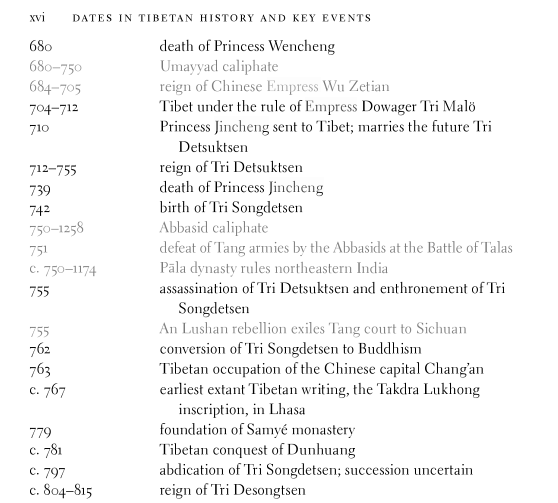
The longer sequence runs like this.
| Date | Event |
|---|---|
| 1st century BCE | The Pali canon, with the prophecy of the Buddha Metteyya (DN 26), is written down in Sri Lanka |
| c. 95 CE | Revelation describes Armageddon and the rider on the white horse |
| by c. 400 CE | The Mahabharata names Kalki, son of Vishnuyashas of the village of Shambhala |
| 515 | Faqing’s rising: “a new Buddha has entered the world” |
| 558 | Huisi’s vows set out the three ages of the Dharma |
| 566 | Narendrayasas translates the Candragarbha, with five periods of five hundred years |
| 610 | White-clad rebels proclaim Maitreya at the Sui palace gate |
| 610 | Muhammad’s first revelation, by Muslim tradition |
| 613 | Song Zixian and Xiang Haiming claim to be Maitreya |
| 684 to 705 | Wu Zetian rules, as regent and then as emperor |
| 695 | Wu adds Maitreya’s name to her title |
| 710 | Princess Jincheng is sent to Tibet |
| c. 1025 to 1040 | The Kalachakra Tantra is written; its calendar starts in 1027 |
| 1052 | Mappo begins, by Japanese reckoning |
| 1516 | Selim I defeats the Mamluks at Marj Dabiq |
| 2327 | Raudrachakrin, the 25th Kalki, takes the throne of Shambhala |
| 2424 | The Kalachakra’s final war |
The Kalachakra, written four centuries after Muhammad, assembled its end-time from these older parts: a king named Kalki, a village called Shambhala, a wheel-turning ruler, an age in decline and a renewal after it. Islam entered the scheme as the enemy. It was not where the scheme came from.
The Kalachakra’s war
The tantra’s own prophecy is precise. Its verse on the foreign teachers, I.154 in the Abridged Kalachakra Tantra, runs in Berzin’s translation:
Adam, Noah, Abraham, and five others, Moses, Jesus, the White-Clad One, Muhammad, and Mahdi, with tamas, are in the asura-naga caste. The eighth will be the blinded one. The seventh will manifestly come to the city of Baghdad in the land of Mecca.
Abridged Kalachakra Tantra I.154, tr. Berzin
The prediction is credited to Manjushri Yashas, the first Kalki, whom the tradition places in the second century BCE. The invasion is to come in 2424, eighteen hundred years after the founding of the invaders’ religion. In 2327 the twenty-fifth Kalki, Raudrachakrin, “the wrathful wheel-holder”, will take the throne, and in the tantra’s words “the Lord of the Gods, joined with the twelve lords, shall go to destroy the barbarians” (Newman 1987, 645). The Kalachakra itself, as The Kingdom at the End of Time describes, ranks the inner reading of that war above the outer one.
A later saying is often added to these prophecies: that the Dharma will flourish “when the iron bird flies”. It is quoted everywhere as a prophecy of Padmasambhava, usually without a source.
Dabiq has already had its battle, of a kind. The war of 2424 is four centuries away. Dogen’s answer to the decline of the Dharma did not need a date at all.
Works consulted
- Berzin, Alexander. “The Kalachakra Prophesies of a Future Invasion.” Study Buddhism.
- al-Bukhari. Sahih al-Bukhari, report of ‘Awf ibn Malik on the six signs.
- Chappell, David W. “Early Forebodings of the Death of Buddhism.” Numen 27, no. 1 (1980): 122 to 154.
- Forte, Antonino. Political Propaganda and Ideology in China at the End of the Seventh Century. 2nd ed. Kyoto: Italian School of East Asian Studies, 2005.
- Marra, Michele. “The Development of Mappo Thought in Japan.” Japanese Journal of Religious Studies 15 (1988).
- Muslim ibn al-Hajjaj. Sahih Muslim, 2897, and the report of al-Nawwas ibn Sam’an.
- Newman, John. “The Outer Wheel of Time: Vajrayana Buddhist Cosmology in the Kalacakra Tantra.” PhD diss., University of Wisconsin, 1987. Cited through Trimondi.
- Okar Research. “Malahim, Armageddon, the Mappo Cycle & Kalachakra Prophecies.”
- The Holy Bible, King James Version.
- Trimondi, Victor and Victoria. “The Shadow of the Dalai Lama,” part 1, chapter 10.
- van Schaik, Sam. Tibet: A History. New Haven: Yale University Press, 2011.
- Walshe, Maurice, trans. The Long Discourses of the Buddha: A Translation of the Digha Nikaya. Boston: Wisdom Publications, 1995.