
The Geology of the Soul
On Jung's layered unconscious, Clauß's race souls, and what the evidence shows
Introduction
In the notes of a seminar he gave in 1925, Carl Jung included a diagram of the human mind as a range of mountains. The peaks were individuals. Below them the mountains joined, first into families, then clans, then a nation, then a group of nations he labelled “European man.” Further down came the primate ancestors and the animal ancestors, and at the bottom a “central fire.” He called the picture the “geology” of a personality.
In that picture the nation is a layer of the psyche, below the person and above the species. Eight years later the layer had become a political matter. In 1933 Jung took over the presidency of a medical society for psychotherapy, whose German section was run by a cousin of Hermann Göring, and in its journal the next year he wrote that the “Aryan” unconscious had “a higher potential than the Jewish.”
In the same years a German race theorist trained in philosophy, Ludwig Ferdinand Clauß (also written Clauss), was teaching that every race has a soul of its own, a style of living that shows in the face and the gesture, and that a trained observer could learn to see it. To study one such soul he went to live in Transjordan as a Bedouin.
This essay sets the two men side by side, asks whether either read the other, and ends with what genetics and cross-cultural psychology have found since.
The collective unconscious
One of Jung’s plainest definitions came late, in a lecture to the Abernethian Society at St Bartholomew’s Hospital in London on 19 October 1936. “The collective unconscious is a part of the psyche which can be negatively distinguished from a personal unconscious by the fact that it does not, like the latter, owe its existence to personal experience and consequently is not a personal acquisition.” Its contents, he went on, “have never been in consciousness, and therefore have never been individually acquired, but owe their existence exclusively to heredity.”
Then he stated his thesis:
In addition to our immediate consciousness, which is of a thoroughly personal nature and which we believe to be the only empirical psyche (even if we tack on the personal unconscious as an appendix), there exists a second psychic system of a collective, universal, and impersonal nature which is identical in all individuals. This collective unconscious does not develop individually but is inherited. It consists of pre-existent forms, the archetypes, which can only become conscious secondarily and which give definite form to certain psychic contents.
“The Concept of the Collective Unconscious,” 1936, Collected Works 9i, par. 90
Two years earlier, in a lecture for the Eranos meeting at Ascona, he had put it as a matter of depth. “A more or less superficial layer of the unconscious is undoubtedly personal,” but it “rests upon a deeper layer, which does not derive from personal experience and is not a personal acquisition but is inborn.” He chose the word collective, he said, “because this part of the unconscious is not individual but universal; in contrast to the personal psyche, it has contents and modes of behaviour that are more or less the same everywhere and in all individuals.”
The archetypes are what that deeper layer holds, and Jung insisted they were forms without content. “The archetype in itself is empty and purely formal, nothing but a facultas praeformandi, a possibility of representation which is given a priori. The representations themselves are not inherited, only the forms.” He had said so as early as 1918: “It should on no account be imagined that there are such things as inherited ideas. Of that there can be no question. There are, however, innate possibilities of ideas, a priori conditions for fantasy-production, which are somewhat similar to the Kantian categories.” The comparison is to Immanuel Kant’s categories, the frames the mind brings to experience before any experience fills them.
In an essay first written in 1927, “Mind and Earth,” he tied the forms to the body and to the ground under it. The archetypes “are inherited with the brain-structure,” he wrote, and “are thus, essentially, the chthonic portion of the psyche.” Chthonic means of the earth. The word comes back whenever Jung speaks of nations.
The house dream
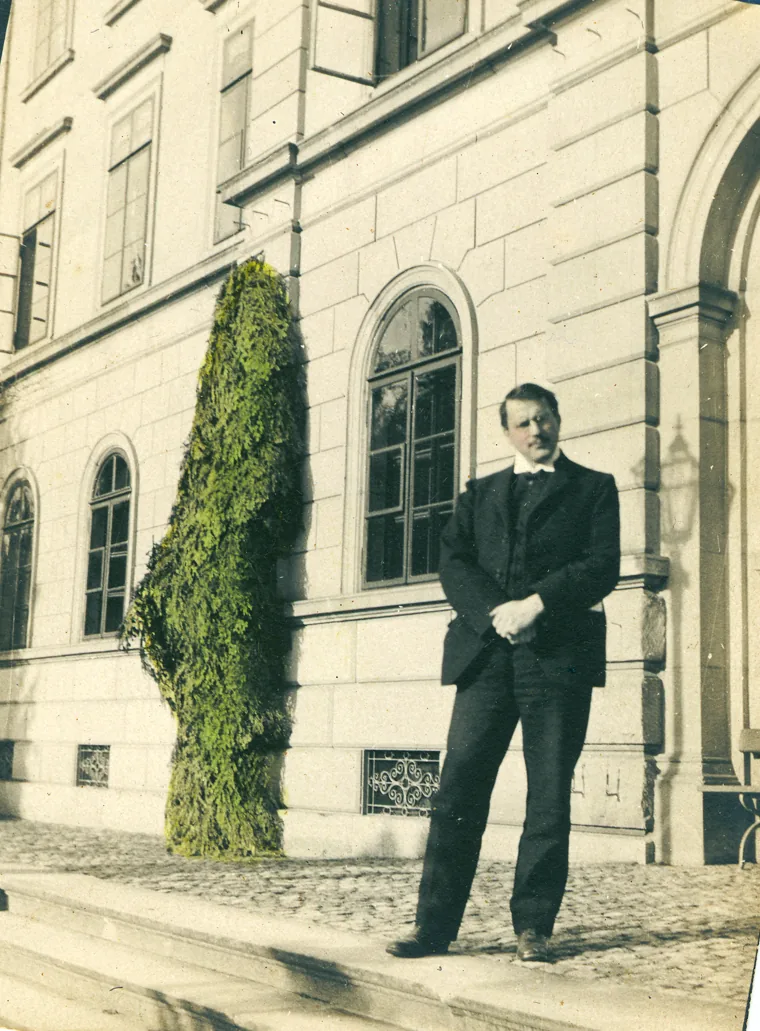
Jung dated the idea to a dream. In 1909 he travelled to the United States with Sigmund Freud for the lectures at Clark University, a journey of seven weeks “which began in Bremen.” In Memories, Dreams, Reflections, the memoir recorded and edited by Aniela Jaffé, he remembered: “We were together every day, and analyzed each other’s dreams. One in particular was important to me, for it led me for the first time to the concept of the ‘collective unconscious.’”
The house in the dream had an upper storey furnished as a rococo salon and a medieval ground floor. Under it was a cellar with Roman walls, and below that “a low cave cut into the rock,” with bones, broken pottery and “two human skulls.”
Freud asked about the skulls, and Jung, by his own account, lied about whose they were: “My wife and my sister-in-law.” His own reading was different. “My dream thus constituted a kind of structural diagram of the human psyche; it postulated something of an altogether impersonal nature underlying that psyche.” It was, he wrote, his “first inkling of a collective a priori beneath the personal psyche.”
He had told the dream before, in the 1925 seminar, and that telling differs in its details. There it came “On my way back from America,” the rooms ran from “a vaulted Gothic room” down to “another cellar, this one of very ancient structure, perhaps Roman,” and a hole in its floor opened onto “a tomb filled with prehistoric pottery, bones, and skulls.” He called the dream “the origin of my book on the Psychology of the Unconscious,” the book of 1912, Wandlungen und Symbole der Libido, that ended his friendship with Freud and was later revised as Symbols of Transformation. And he said what he had believed before it: “I had no idea of the collective unconscious; I thought of the conscious as of a room above, with the unconscious as a cellar underneath and then the earth wellspring, that is, the body, sending up the instincts.”
The house stayed with him. In “Mind and Earth” it became a building with a nineteenth-century upper storey, a sixteenth-century ground floor and an eleventh-century tower. “In the cellar we come upon Roman foundations, and under the cellar a choked-up cave with neolithic tools in the upper layer and remnants of fauna from the same period in the lower layers. That would be the picture of our psychic structure.”
Mountains out of a sea
In the notes of the seminar’s lecture of 6 July 1925, Jung gave the house a second form, closer to a geological section:
I have often been asked about the “geology” of a personality, and so I have tried to picture this after a fashion. Diagram 10 shows individuals coming out of a certain common level, like the summits of mountains coming out of a sea. The first connection between certain individuals is that of the family, then comes the clan which unites a number of families, then the nation which unites a still bigger group. After that we could take a large group of connected nations such as would be included under the heading “European man.” Going further down, we would come to what we could call the monkey group, or that of the primate ancestors, and after that would come the animal layer in general, and finally the central fire, with which as the diagram shows, we are still in connection.
Analytical Psychology: Notes of the Seminar Given in 1925, p. 133
The labels, from top to bottom, are individuals, families, clans, nations, “Large Group (European man, for example),” primate ancestors, “Animal Ancestors in general,” and “Central Fire.” A note in the printed seminar records that “Dr. Jung added to the notes supplementary material as well as the appendix which follows,” so this passage may be something he wrote into the notes afterwards and not something he said in the room. Either way it carries his name, and it puts the nation into the unconscious as plainly as anything he wrote.
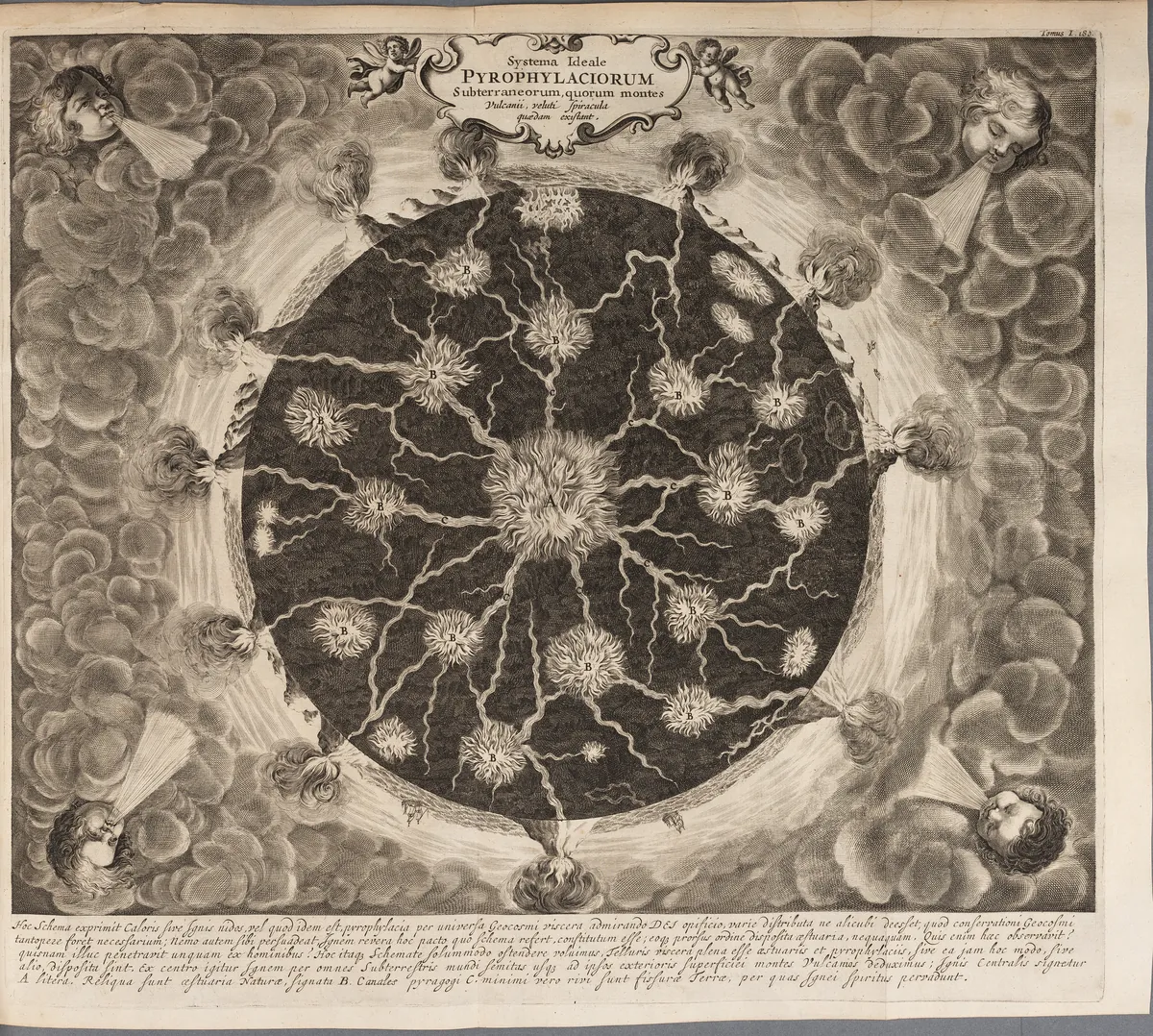
The central fire is an old picture of the inside of the world. Athanasius Kircher engraved one for his Mundus subterraneus in 1665, with channels running from a fire at the core to chambers under the mountains. Jung’s diagram has the same structure, applied to the mind: whatever a person is at the summit, the mountain goes all the way down to the fire.
Common to all, and different by race
Jung held two positions about the deeper layers, and he held them at once.
The first is that the deep layer is the same for everyone. In 1912, at the invitation of William Alanson White, he studied patients at St Elizabeths Hospital in Washington, a piece of research the historian Sonu Shamdasani has reconstructed. Jung reported the result in 1929, in the language of the time. Finding mythological motifs in people who could not have learned them, “my original idea that such things could only happen to people belonging to the same race was shattered, and I accordingly investigated the dreams of pure-bred Negroes living in the southern United States. I found in these dreams, among other things, motifs from Greek mythology, and this dispelled any doubt I had that it might be a question of racial inheritance.” The likenesses came instead from “the inherited disposition to react in the same way as people have always reacted.” In Symbols of Transformation he wrote: “It is not a question of a specifically racial hereditary, but of a universally human characteristic.” Shamdasani adds that Jung gave only one worked example from the study.
The second position is that the layers above the deepest one differ by race. It appears most plainly in a footnote to The Relations between the Ego and the Unconscious, a book of 1928 that Jung revised in later editions; when the note first appeared is not settled. In the text he warns against identifying with the collective psyche, which brings “a ruthless disregard not only of individual differences but also of differences of a more general kind within the collective psyche itself, as for example differences of race.” The footnote reads:
Thus it is a quite unpardonable mistake to accept the conclusions of a Jewish psychology as generally valid. Nobody would dream of taking Chinese or Indian psychology as binding upon ourselves. The cheap accusation of anti-Semitism that has been levelled at me on the ground of this criticism is about as intelligent as accusing me of an anti-Chinese prejudice. No doubt, on an earlier and deeper level of psychic development, where it is still impossible to distinguish between an Aryan, Semitic, Hamitic, or Mongolian mentality, all human races have a common collective psyche. But with the beginning of racial differentiation essential differences are developed in the collective psyche as well.
Collected Works 7, par. 240, note 8
That is the 1925 diagram in a sentence: a shared floor, and racial and national strata built on it. In a newspaper reply of 1934 Jung listed the strata outright. A person’s psychic idiosyncrasy, he wrote, “is conditioned (1) by the individual, (2) by the family, (3) by the nation, race, climate, locality, and history.” And: “Psychological differences obtain between all nations and races, and even between the inhabitants of Zurich, Basel, and Bern.”
Nations in the unconscious, 1918 to 1930
Jung’s remarks about particular peoples began long before the Nazis. The first is in “The Role of the Unconscious,” published in a Zürich magazine, Schweizerland, in 1918, the last year of the war.
There he described the Germanic peoples as carrying an untamed layer that Christianity had only covered. “Christianity split the Germanic barbarian into an upper and a lower half, and enabled him, by repressing the dark side, to domesticate the brighter half and fit it for civilization. But the lower, darker half still awaits redemption and a second spell of domestication.” As Christian belief weakened, he went on, “the more menacingly will the ‘blond beast’ be heard prowling about in its underground prison, ready at any moment to burst out with devastating consequences.” The blond beast is Nietzsche’s phrase.
In the next paragraph he turned to the Jews. “In my opinion this problem does not exist for the Jews. The Jew already had the culture of the ancient world and on top of that has taken over the culture of the nations amongst whom he dwells. He has two cultures, paradoxical as that may sound. He is domesticated to a higher degree than we are, but he is badly at a loss for that quality in man which roots him to the earth and draws new strength from below. This chthonic quality is found in dangerous concentration in the Germanic peoples.” The Jew, he wrote, “has too little of this quality,” and he asked: “where has he his own earth underfoot?” From that he drew a conclusion about the psychotherapy of his day: “these specifically Jewish doctrines are thoroughly unsatisfying to the Germanic mentality; we still have a genuine barbarian in us who is not to be trifled with.” A psychotherapist “with a Jewish background,” he went on, awakens in the Germanic psyche “the barbarian of yesterday, a being for whom matters suddenly become serious in the most unpleasant way.”
The same paragraph has a sentence that shows how much weight Jung put on the soil. “One only needs to see how, in America, the skull and pelvis measurements of all the European races begin to indianize themselves in the second generation of immigrants. That is the mystery of the American earth.”
He developed the idea in “Mind and Earth,” written for a volume edited by Hermann Keyserling in 1927 and rewritten in 1931. A European group moved to “a strange soil and another climate,” he argued, would undergo “certain psychic and perhaps also physical changes in the course of a few generations, even without the admixture of foreign blood.” His example was North America, “the greatest experiment in the transplantation of a race in modern times.” For evidence he cited Franz Boas: “Boas has shown that anatomical changes begin already in the second generation of immigrants, chiefly in the measurements of the skull.” Boas’s 1912 study of immigrants’ children did report changes in head form between parents and children, and Boas used it to argue that differences between races were not fixed. Jung read the same figures as the land at work on its settlers.
His conclusion was stark. “Thus the American presents a strange picture: a European with Negro behaviour and an Indian soul. He shares the fate of all usurpers of foreign soil.” And: “Everywhere the virgin earth causes at least the unconscious of the conqueror to sink to the level of its indigenous inhabitants.” The influence of Black Americans on laughter, gait, music and dance he called “a psychological influence naturally, not due to the mixing of blood.”
He put the same thesis to an American audience in 1930, in an article in the New York Forum titled “Your Negroid and Indian Behavior.” “There is an x and a y in the air and in the soil of a country, which slowly permeate and assimilate him to the type of the aboriginal inhabitant, even to the point of slightly remodelling his physical features.”
So the national layer, for Jung, was inherited and also made by place. Blood was one source of it and earth another, and in America he gave the earth the stronger hand. In 1929 he was also writing that the deepest images were no matter of “racial inheritance.” The national psyche sat between the person and the species, and the soil could reshape it.
1933 to 1940
The society and its journal
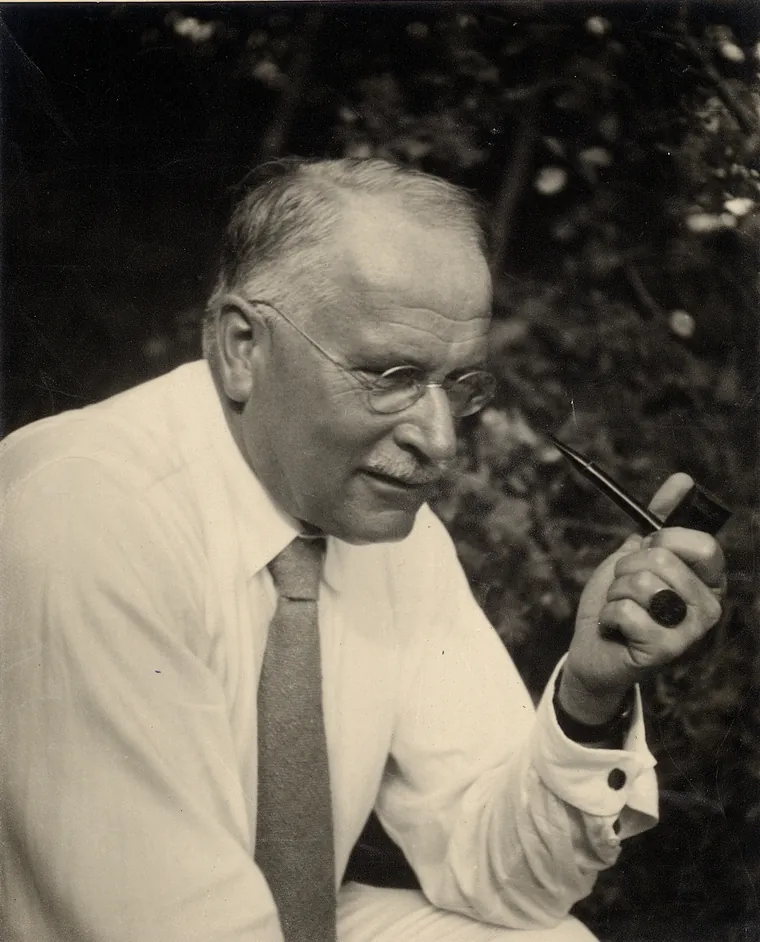
The Allgemeine Ärztliche Gesellschaft für Psychotherapie, the General Medical Society for Psychotherapy, was founded in Germany in 1928 with Robert Sommer as its first president. In 1930 the psychiatrist Ernst Kretschmer became president, with Jung as vice-president. Kretschmer resigned on 6 April 1933, two months after Hitler came to power, and Jung stepped in.
He reorganised the society as an international body, the International General Medical Society for Psychotherapy, with national groups under it. A German section was founded in Berlin on 15 September 1933 under Matthias Heinrich Göring, Hermann Göring’s elder cousin. The new statutes were ratified at a congress at Bad Nauheim from 10 to 13 May 1934. A circular letter of December 1934 let individuals join the international society directly. Ann Conrad Lammers, editor of Jung’s correspondence with the analyst James Kirsch, explains what that meant in practice: German Jewish psychotherapists, barred from the German section, could still be members.
Jung also took on the society’s journal, the Zentralblatt für Psychotherapie. Its first issue under him, in December 1933, carried an editorial of his:
The differences which actually do exist between Germanic and Jewish psychology and which have long been known to every intelligent person are no longer to be glossed over, and this can only be beneficial to science.
The editorial added that “this implies no depreciation of Semitic psychology, any more than it is a depreciation of the Chinese to speak of the peculiar psychology of the Oriental.”
Immediately after it the same issue printed a statement by M. H. Göring, as head of the German section, pledging its loyalty to the new regime. It had been meant for a German special issue. Walter Cimbal, the German section’s secretary, said it was put in by mistake and apologised, and Jung protested to several people, as Lammers shows from the correspondence. Andrew Samuels records that Jung “maintained that he did not know of pro-Nazi statements of principles that were inserted in the Zentralblatt by Professor Goering.”
On 27 February 1934 Gustav Bally attacked the issue in the Neue Zürcher Zeitung under the title “Deutschstämmige Psychotherapie?” (Psychotherapy of German stock?). Jung answered in the same paper on 13 and 14 March. He had faced a choice, he wrote, between staying safe in Switzerland and choosing to “risk my skin and expose myself to the inevitable misunderstandings which no one escapes who, from higher necessity, has to make a pact with the existing political powers in Germany.” He did not retreat on substance. “Admittedly I was incautious, so incautious as to do the very thing most open to misunderstanding at the present moment: I have tabled the Jewish question. This I did deliberately.” He asked: “Why this ridiculous touchiness when anybody dares to say anything about the psychological difference between Jews and Christians? Every child knows that differences exist.” And he called it “a highly unfortunate and disconcerting coincidence that my scientific programme should, without any assistance of mine and against my express wish, have been lined up with a political manifesto.”
The 1934 essay
The passage that has drawn the most criticism is in “The State of Psychotherapy Today,” which Jung published in the Zentralblatt in 1934. It is quoted here at some length.
Jung compared Jews with women: “The Jews have this peculiarity in common with women; being physically weaker, they have to aim at the chinks in the armour of their adversary.” He wrote that “The Jew, who is something of a nomad, has never yet created a cultural form of his own and as far as we can see never will, since all his instincts and talents require a more or less civilized nation to act as host for their development.” And he set the German unconscious apart: “The ‘Aryan’ unconscious, on the other hand, contains explosive forces and seeds of a future yet to be born, and these may not be devalued as nursery romanticism without psychic danger.”
The next paragraph holds the sentence quoted at the start of this essay:
The “Aryan” unconscious has a higher potential than the Jewish; that is both the advantage and the disadvantage of a youthfulness not yet fully weaned from barbarism. In my opinion it has been a grave error in medical psychology up till now to apply Jewish categories, which are not even binding on all Jews, indiscriminately to Germanic and Slavic Christendom.
Collected Works 10, par. 354
In the same paragraph Jung wrote that the Jewish race as a whole “possesses an unconscious which can be compared with the ‘Aryan’ only with reserve,” and that “my own warning voice has for decades been suspected of anti-Semitism. This suspicion emanated from Freud.” He asked whether his critics had learned anything from events: “Has the formidable phenomenon of National Socialism, on which the whole world gazes with astonished eyes, taught them better?”
Critics point to other documents from the same months. Samuels cites a 1933 interview on Radio Berlin in which Jung spoke about the Führer, and a letter to W. M. Kranefeldt of 9 February 1934 that called Freud’s and Adler’s views “specifically Jewish” and gave them “an essentially corrosive character.” In 1934 Jung and M. H. Göring signed a birthday greeting to Robert Sommer praising his work on “Familienforschung, Vererbungs- und Rassenlehre,” family research, heredity and racial science.
The journal itself was under steady German pressure. The managing editorship passed to C. A. Meier. “Egregiously racist writings were rejected for publication,” Lammers writes, while others “with implicitly racial and nationalist themes, were sometimes accepted.”
Wotan
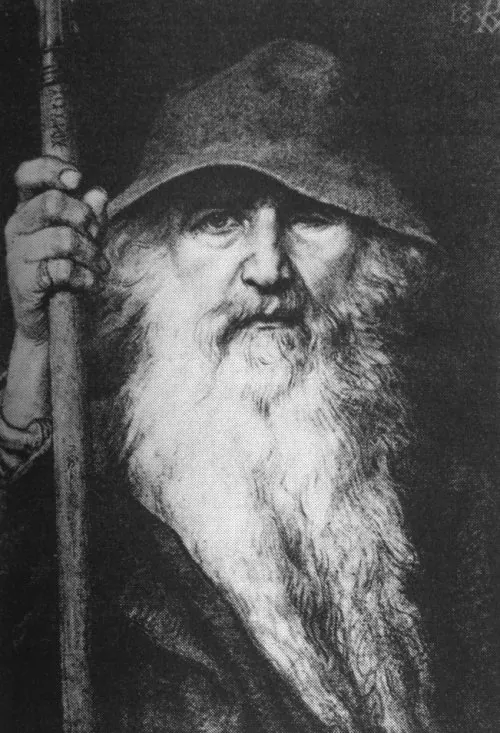
By 1936 Jung’s tone had changed. In “Wotan,” published in the Neue Schweizer Rundschau in March of that year, he described the German movement as possession by a god. It was strange, he wrote, that “an ancient god of storm and frenzy, the long quiescent Wotan, should awake, like an extinct volcano, to new activity, in a civilized country that had long been supposed to have outgrown the Middle Ages.”
He used the German words for it. Being seized requires “not only an Ergriffener (one who is seized) but also an Ergreifer (one who seizes). Wotan is an Ergreifer of men.” Of the leader he wrote: “The impressive thing about the German phenomenon is that one man, who is obviously ‘possessed,’ has infected a whole nation to such an extent that everything is set in motion and has started rolling on its course towards perdition.”
Here the national layer of the 1925 diagram shows its other face. Wotan, Jung wrote, “is a fundamental attribute of the German psyche, an irrational psychic factor which acts on the high pressure of civilization like a cyclone and blows it away.” He spoke of “the Wotan-archetype,” a figure belonging to one people. “Archetypes are like riverbeds which dry up when the water deserts them, but which it can find again at any time.”
He discussed a book by the Tübingen Indologist Jakob Wilhelm Hauer, leader of the German Faith Movement, who had given a seminar on Kundalini yoga together with Jung in 1932. Near the end comes this sentence: “We who stand outside judge the Germans far too much as if they were responsible agents, but perhaps it would be nearer the truth to regard them also as victims.”
Leaving the society
Jung offered to resign as president on 21 December 1935, after the Dutch group withdrew its invitation to host the congress. The editors of his letters note that “This resignation did not become effective.” In July 1939 he tendered it again at a meeting of delegates in Zürich, “because I was firmly resolved to give up the running of the Society,” as he told J. H. van der Hoop in 1940. He stayed until new groups from Italy, Hungary and Japan had been dealt with, and made the resignation final in 1940. Göring, Jung wrote, “declared that I was too old anyway to understand the new developments.”
Jung later said that after the German edition of his Terry Lectures appeared in 1940, “I myself figured on the Nazi black list.” Lammers, citing Deirdre Bair’s biography, notes his wartime work with Allen Dulles of American intelligence. William Schoenl, who has followed Jung’s views year by year, finds that during the war they were strongly anti-Nazi.
After the catastrophe
What Jung said later
In 1945 Jung published “After the Catastrophe” in the Neue Schweizer Rundschau. He wrote of his own “inner identity or participation mystique with events in Germany,” which had made him “experience afresh how painfully wide is the scope of the psychological concept of collective guilt.” He dismissed the regime’s science: “The pseudo-scientific race-theories with which it was dolled up did not make the extermination of the Jews any more acceptable.” And he read antisemitism as a German projection: “Just think for a moment what anti-Semitism means for the German: he is trying to use others as a scapegoat for his own greatest fault!”
A year later he collected his political essays in a book and added an epilogue. In it he quoted his 1918 sentence about the blond beast as proof that he had seen the danger early. “Murder is murder,” he wrote, “and the fact that the whole German nation threw itself with all its might into the most infamous war of aggression in history is a crime that nothing can ever wipe out.” The national layer was still there: “Nations have their own peculiar psychology, and in the same way they also have their own particular kind of psychopathology.”
He also explained why he had waited. “When Hitler seized power it became quite evident to me that a mass psychosis was boiling up in Germany,” and yet the figure of the Führer “at first struck me as being merely ambivalent.” He went on:
National Socialism was one of those psychological mass phenomena, one of those outbreaks of the collective unconscious, about which I had been speaking for nearly twenty years. The driving forces of a psychological mass movement are essentially archetypal.
“Epilogue to ‘Essays on Contemporary Events,’” 1946, Collected Works 10, par. 474
His “medical attitude towards such things counselled me to wait,” he wrote, and to give things “a fair trial.” The epilogue does not return to the 1934 sentences about the “Aryan” and the Jewish unconscious. Its only mention of Jews comes where he denies that Nazism was “forced on the German people by the Freemasons, the Jews, or the wicked English.”
His private remarks went in both directions. In a letter of 18 April 1946 to the English analyst Michael Fordham he traced the charge to its source as he saw it: “The story of my anti-semitism and Nazi-sympathies originally started with the holy father Freud himself.” The same year he met Rabbi Leo Baeck in Zürich. The words he used there are known only at second hand: Baeck told Gershom Scholem, who told Aniela Jaffé, who printed them in 1971. Jung, by that report, said “Ich bin ausgerutscht,” I slipped up. James Kirsch later wrote of an apology Jung made to him in August 1947 for “his ill-timed and ill-chosen words in the 1934 issue of Zentralblatt.”
How others have judged it
The judgements differ.
Aniela Jaffé, his secretary and a Jewish pupil, wrote “C. G. Jung and National Socialism” in 1971. She defended him, “though not uncritically,” in Lammers’s phrase, and set his mistakes against the help he gave Jews and non-Jews in the Nazi years. James Kirsch had accepted Jung’s account in 1934, organised support for him, and later wrote “Reconsidering Jung’s So-Called Anti-Semitism” (1984).
Scholem went back to the Eranos meetings in 1947, after hearing of the apology to Baeck. Lammers adds that “He never softened his opinion, however, that Jung had had ‘links’ to Nazism in the 1930s, and that some of Jung’s statements at the time had been harmful and unjustifiable.”
Andrew Samuels, a Jungian analyst and professor at Essex, asked in the early 1990s whether something “in the deep, fundamental structure of Jung’s thought” led to antisemitism. “My brief answer, in contradistinction to that of many other leading Jungian analysts, is ‘yes.’” His argument was that “in C.G. Jung, nationalism found its psychologist”: Jung’s fear of a “levelling” Jewish psychology ran parallel to Hitler’s fear of a “denationalizing” Jewish politics. Samuels still held that Jung’s “intuition of the importance of exploring difference remains intact,” and he concluded that “Jungians have some reparation to make.”
In 1989 Jungian analysts met in New York, and in workshops at the Paris congress of the International Association for Analytical Psychology, to take up the question in public. Their papers appeared in 1991 as Lingering Shadows: Jungians, Freudians, and Anti-Semitism, edited by Aryeh Maidenbaum and Stephen A. Martin. Maidenbaum wrote in 2013 that Jewish Jungians “generally do not consider Jung anti-Semitic on a personal level,” but that “Private statements, even to Jewish leaders, that he ‘slipped up’ were not enough, and criticism of him in this context is deserved.”
Shamdasani reads the statements through Jung’s interest in the “personal equation,” the old astronomers’ term for the bias an observer brings to a measurement. “It is critical to see such statements in the context of the problem of the personal equation. Jung was suggesting that this was also racially conditioned.” On that reading, Jung was claiming that every psychology bears the stamp of its maker, and that the stamp includes race. William and Linda Schoenl, studying the first year of Nazi rule, conclude that “although he occasionally made some anti-Semitic statements during this early period, he was not anti-Semitic in the way the Nazis were,” and that after Bally’s attack Jung “became warier both of the Nazis and of making any statements that could be construed as being anti-Semitic.” Geoffrey Cocks, the historian of psychotherapy in the Third Reich, found that Jung’s ideas had “official approval” there and that “German psychotherapists did all they could to link Jung’s name with their own activities.”
None of them disputes the texts, and in 1934 the texts rank one people’s unconscious above another’s.
Ludwig Ferdinand Clauß
Husserl’s student
Ludwig Ferdinand Clauß, also written Clauss, was born in Offenburg in Baden on 8 February 1892 and died at Huppert in the Taunus on 13 January 1974. He studied philosophy at Freiburg under Edmund Husserl, the founder of phenomenology, the discipline that sets out to describe experience exactly as it presents itself, before theory gets to it.
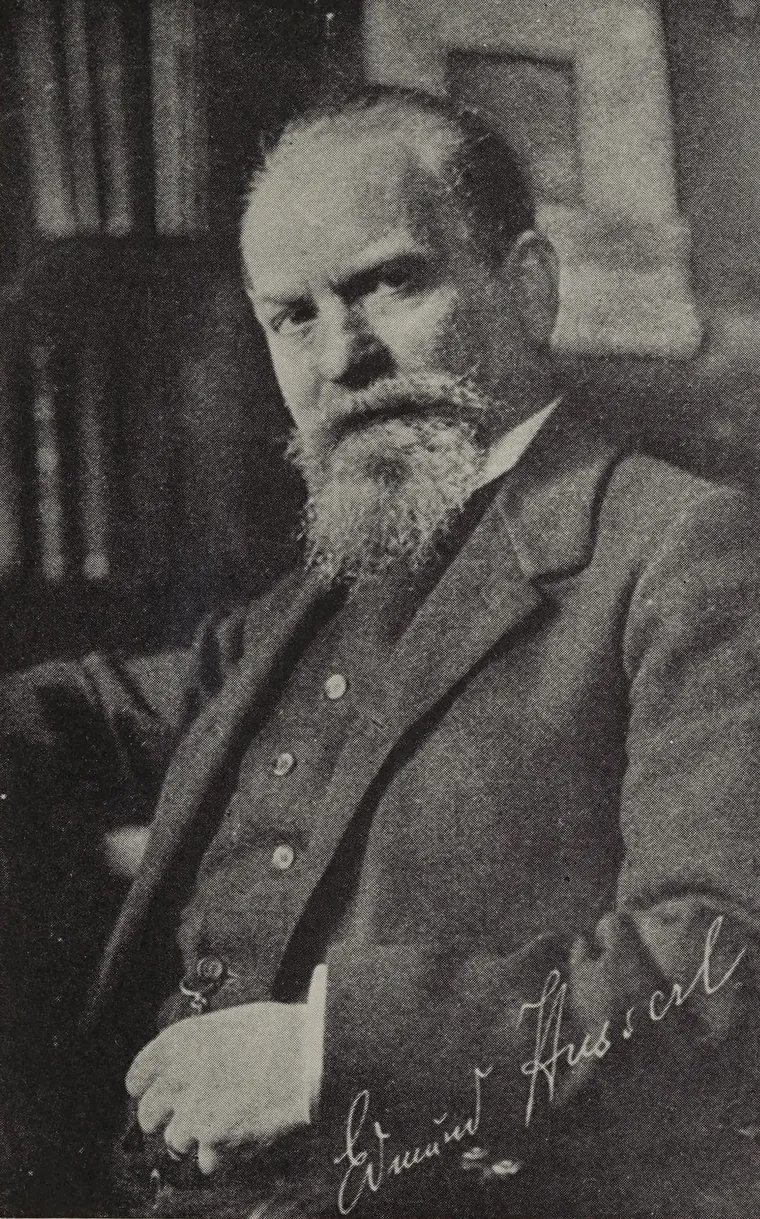
Clauß said so himself. In the preface to Rasse und Seele, dated Freiburg, autumn 1925, he wrote that he owed “the most and the best” to “my former teacher, Professor Edmund Husserl in Freiburg; from him I learned the working method of my research.” The philosopher Robert Bernasconi sums up what Clauß did with it: he was “a student of Husserl and during the 1920s he wrote three books which sought to show that Husserlian phenomenology had made possible for the first time a rigorous concept of race.”
Husserl was born into a Jewish family in Moravia and baptised a Lutheran in 1886. In 1933 he was among those forced to break their ties with the University of Freiburg. On 4 May of that year he wrote that the future alone would judge “who were the true Germans,” those who held “the more or less materialistic-mythical racial prejudices of the day,” or those “pure in heart and mind.”
Clauß’s first books came out in the 1920s. He translated songs of the Poetic Edda in 1921. Die nordische Seele, The Nordic Soul, appeared in 1923 and was rewritten in 1932; from 1934 it carried the subtitle Eine Einführung in die Rassenseelenkunde, An Introduction to the Study of Race Souls, and it reached an eighth edition in 1940. Rasse und Seele, Race and Soul, appeared in 1926, was revised in 1933, and went through many printings, among them a twelfth in 1938. Later came Von Seele und Antlitz der Rassen und Völker (1929), On the Soul and Face of Races and Peoples, and in the Nazi years Rasse ist Gestalt! (1937), Race Is Form!, from Eher, the party’s own publisher.
Style, not measurement
What set Clauß apart from most race theorists of his day was his refusal to start with calipers. Race, as he described it, was a style.
He made the point with buildings. “By kind we mean a unity of style,” he wrote in 1926 (“Artung bedeutet uns: eine Einheit des Stiles”). A Gothic cathedral and an Egyptian pyramid might both stand about 150 metres high, yet each has “a different way of being high, that is, they have a different style of height.” A Nordic Viking and a desert Bedouin might have equal courage, but, he wrote, “not in the measure of the quality ‘courage’ but in the style of this courage does the law of kind work.” The style always comes first. In his words, “the law of kind (the psychic style) always remains the first thing, and the stock of qualities something derived.”
In the 1940 edition of Die nordische Seele he turned the same argument against measurement. Nobody understands a Gothic cathedral by running up it “mit dem Winkelmaß,” with a set square. The exact methods of physics can establish that a Nordic body and a Phalian body are each “exactly 180 centimetres” tall, “but no intuition of the form ever grows out of these figures.” The question was what “way of experiencing” a body’s style expressed. The Nordic figure, he wrote, “has a completely different way of being tall.”
So Clauß did not deny that races were bodily and inherited. The subtitle of his revised Rasse und Seele was An Introduction to the Meaning of the Bodily Form. What he claimed was that the unit of race was a psychic style shown through the body, and that it had to be seen, not counted. The historian Felix Wiedemann puts it in a line: “Clauß thought little of skull measurements and similar methods used by other race researchers. His approach demanded fathoming without distance, through direct ‘Mitleben.’”
Living with, and the camera
Mitleben means living with, or living along with. Clauß called it the mimic method. The researcher, he wrote, must put his own racial attitude out of action “for the duration of mimic living-with the people of the race whose soul is to be fathomed.” In the revised Rasse und Seele the six type sections are followed by chapters on “the mimic method,” on the stuff and the style of expression, on changes of style in expression, and on “the body as the stage of expression.”
He knew how easy it sounded. “Travel there, look for where life is still ‘genuine,’ and then live with the people,” he wrote in 1937. “And yet everything in entering foreign worlds depends on how far we are able to leave our own world aside there.”
The camera was his notebook. His books are full of photographs, taken in series to catch one person from many sides, and he was careful about what they were for. In Die nordische Seele he called them aids to the eye:
These pictures are not meant to prove anything. Our research does not start from pictures but from life seen and lived along with. There is no picture among them that the author did not take himself.
Amos Morris-Reich, in his history of racial photography, treats Clauß’s pictures as “thought experiments,” and Richard T. Gray gives him a chapter in a study of German physiognomic thought from Johann Kaspar Lavater to Auschwitz.
Six souls
By the 1930s Clauß had settled on six race souls. He named each after what he took to be the highest value in its range of values. The table gives his names, a rough English rendering, and the race to which he attached each one.
| Clauß’s name | In English, roughly | The race, in his scheme |
|---|---|---|
| Leistungsmensch | the man of achievement | Nordic (nordisch) |
| Verharrungsmensch | the man of persistence | Phalian (fälisch) |
| Darbietungsmensch | the man of display | Mediterranean (mittelländisch) |
| Offenbarungsmensch | the man of revelation | desert (wüstenländisch), earlier called Oriental |
| Erlösungsmensch | the man of redemption | Near Eastern (vorderasiatisch) |
| Enthebungsmensch | the man of release | Eastern, also called “Alpine” (ostisch) |
For the Nordic type the governing value, in his account, was achievement: he spoke of “the style of achievement and men of achievement, because for the man of this style achievement is the leading value.” His explanation of the desert type shows the method at work. In desert life, he wrote, “‘booty’ becomes the least thing and the most exalted. In the sphere of faith it is called ‘miracle’ and, catchable then only for the chosen, ‘revelation.’ Revelation too ‘falls to one’ by ‘the grace’ of God. Revelation is, it seems, the highest value in the range of values of this kind of man, and so we call it the man of revelation.” He named the race after the “wide country of the Arabian steppes,” hence wüstenländisch, desert-land, and called it “the race of the original Semite.” In a footnote he rejected the older name, “Oriental race.”
The scheme was not fixed from the start. The first edition of Rasse und Seele, in 1926, has no “-mensch” types at all. Its section on psychic forms describes “pure forms,” the Nordic soul, the Mediterranean soul and some “remarks on the Oriental soul,” and then, under the heading “disturbed forms,” the Eastern soul (die ostische Seele), with a preliminary note on the “faults” and “infirmities” of a race. By the revised text of 1933 all six had become styles of equal rank in the book’s arrangement, the “Oriental soul” had become the man of revelation, a separate Near Eastern man of redemption had appeared, and the Phalian man of persistence had been added. The 1926 edition already placed the Jews within the scheme: “Jewry, which is composed mostly of these two races,” the Near Eastern and the Oriental.
That split between desert and Near East carried the politics. Wiedemann has shown that Clauß built a “double” Orient and “made a sharp distinction between Arabs and Jews.” In his account, “a romanticized Arabic Orient served as an antipole to a ‘Nordic’ Europe,” while “The Jewish Orient, on the other hand, embodied for Clauß a threatening ambivalence and contrariety.” Elsewhere Wiedemann notes that the Near Eastern race stood in Clauß’s writing for city life, race mixing, usury and fraud, the stock themes of European antisemitism, and that Clauß placed “the Jewish people” at its centre.
Among the Bani Sakhr
“When I entered the East in the spring of 1927,” Clauß wrote. By Wiedemann’s reconstruction he went first to Damascus and then settled for a time in Jerusalem. What he saw there displeased him. He called Western influence in the East a “wicked violation and confusion of foreign laws of kind,” and wrote that the East should “cast out this stranger,” by which, Wiedemann explains, he meant the Jewish immigrants.
From Jerusalem he went into the desert. Dressed “as a Bedouin of rank,” he hired a car at the Damascus Gate and drove to Amman, in what was then the Emirate of Transjordan. There he called on Mithqāl Pasha ibn Sattām, whom he describes as the most powerful shaykh of the Banī Ṣakhr, and had himself announced as “Muhammad Ferid, shaykh of the German Bedouins.” Wiedemann gives the fuller form, Muhammad Ferid el-Almani, “the German,” and reports that Clauß stayed with the tribe for four years.
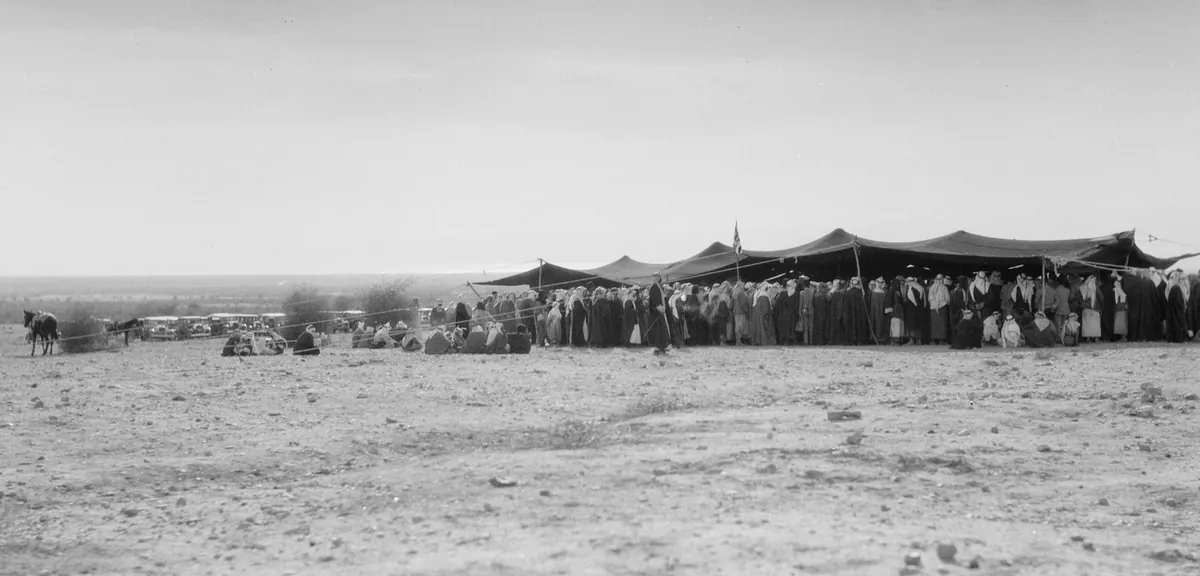
He lived as a Muslim. Townspeople, he wrote, could see “that I lived as a Muslim,” and he admitted one lapse: “On this one point I was quite often a bad Muslim, for I am an enthusiastic late sleeper.” Whether he formally converted is less clear. The German national library’s record of him says he converted to Islam, and Wiedemann writes that to become a Bedouin in his whole being he had to take on Islam, which Clauß regarded as the religion proper to the Arabs. No source consulted for this essay gives a date, a place or a witness, or says whether he remained a Muslim.
He was not alone. Margarete Landé had known him since their student years in Freiburg and had gone to Palestine as a Zionist in the early 1920s; by Wiedemann’s account Clauß met her again in Jerusalem, and she went with him into the desert. In his book she appears as Sitt Marjam, and through her, Wiedemann writes, Clauß had access to the women’s side of the tent.
The results were two books: Als Beduine unter Beduinen, As a Bedouin among Bedouins (1933), with twenty-six pictures from his own photographs, and an expanded version, Semiten der Wüste unter sich, Semites of the Desert among Themselves (1937), subtitled Miterlebnisse eines Rassenforschers, a race researcher’s experiences lived alongside. Its preface, dated summer 1937, has this sentence: “We cleanse ourselves when we recognise the foreign as foreign.”
Clauß and the Nazi state
By 1937 Clauß was teaching at the University of Berlin, and he wrote in that year’s preface of his “work in the service of the new Reich.” Wiedemann, writing in 2009, counts him among “the most influential race researchers of the Nazi period.” In Wiedemann’s account he called for the “cleansing” of the German people from influences “foreign to their kind” and for a return to a “Nordic” heritage, and in völkisch circles he rose to be an expert on Islam.
That expertise found work. With the SS anthropologist Bruno Beger, Clauß took part in a special project of the SS research foundation, the Ahnenerbe, called “Rassen im Kampf,” Races in Combat. Its aim, as Wiedemann describes it, was to study the fighting behaviour of “alien races,” with the Muslim units of the Waffen-SS in Bosnia as the example. In that context Clauß stressed what he called the “close ideological neighbourhood” of National Socialism to the world of Islamic belief.
Then the party turned on him. In 1943 he was expelled from the Nazi Party because of Margarete Landé. Employing a Jewish woman was forbidden, and it was rumoured that the two had lived together. He did not give her up. In the last years of the war he hid her on his estate in Brandenburg, out of the Gestapo’s reach. The United States Holocaust Memorial Museum records that Landé, born in 1894 into a family that had converted to Christianity, “survived the Holocaust in hiding with assistance from the Nazi race theorist Ludwig Clauss, a former colleague with whom she had long-standing relationship.”
After 1945
Clauß never had an academic career in Germany again. According to Wiedemann he travelled through the Arab countries in his camper van, set his hopes on the Islamic fundamentalism then emerging, and rejected Arab nationalism; only Islam, he believed, could save the world from falling into the total materialism of the West. He published Umgang mit Arabern des Ostens (1949), three novels in the 1950s, and Die Seele des Andern (1958), The Soul of the Other. His student Sigrid Hunke carried many of his ideas forward, above all in Allahs Sonne über dem Abendland (1960). In 2004 the Olms publishing house, reissuing his books on the Arabs, called him an “outstanding authority on the Islamic world.”
The strangest part of his reception came after his death. Yad Vashem recognised him as one of the Righteous Among the Nations for hiding Landé; Wiedemann gives the year as 1981. Fifteen years later, by the same account, the title was withdrawn. Mordecai Paldiel, who directed the department for the Righteous from 1982 to 2007, named Clauß as one of about half a dozen people removed from the list because he “turned out to have been a prominent exponent of Nazi racialist ideology.”
Peter Weingart’s 1995 book on him, built on archives and interviews, is called Doppel-Leben, Double Life, with the subtitle Between Race Research and Resistance. Philosophers have since taken up the question Clauß himself raised: whether phenomenology could ground a theory of race. Bernasconi, Andrzej Gniazdowski and, in 2026, Gerhard Thonhauser have all written on his Rassenseelenkunde, the last setting it against the present-day critical phenomenology of race.
Did they read each other?
Jung and Clauß worked in the same years, wrote in the same language, and wrote about some of the same things: the soul of a people, its tie to the soil, the difference between Germans and Jews. It would be natural to suppose they read each other. No evidence has turned up that they did. A search of Jung’s Collected Works, the first volume of his published letters (1906 to 1950), his main published seminars, his correspondence with Kirsch, Shamdasani’s history of Jung’s psychology and Samuels’s essays found no mention of Clauß. The likeliest place for a trace is the Zentralblatt für Psychotherapie, which Jung edited from 1933 to 1940 and which might have reviewed Clauß’s books, and it has not been searched for this essay. The absence is a finding about the sources searched, not proof that the two never noticed each other.
Set side by side, the two schemes differ in where they put the difference. Jung’s nations and races are layers of an unconscious, mostly out of sight, reached through dreams and myths and, in 1936, through a mass movement. Clauß’s races are styles visible on the surface, in a face or a gesture, and reached by a trained eye. Both men tied souls to land. Jung had the American earth remake its settlers; the 1926 Rasse und Seele has a section on “Seele und Landschaft,” soul and land, “Nordland und Südland,” and Clauß named his desert soul after the steppe.
Both also described whole peoples from impression. Clauß made a method of it and wrote that his photographs proved nothing. Jung appealed to what “every intelligent person” and “every child” knows. That is the claim modern research has been able to test.
What the evidence shows
Genes and populations
In 1972 the geneticist Richard Lewontin asked how human genetic variation is divided up. Working from blood groups and proteins, he found that “85.4% of the total diversity of the human species is within populations, 8.3% is among populations but within races and 6.3% is among races.” Two people from the same population differ, on average, almost as much as two people from different continents.
Later work with far more data came out in the same place. In 2002 Noah Rosenberg and colleagues studied 377 genetic markers in 1,056 people from 52 populations. “Within-population differences among individuals account for 93 to 95% of genetic variation; differences among major groups constitute only 3 to 5%.” The same study also showed something Lewontin’s figure can hide: with no information about where people came from, a clustering program sorted them into “six main genetic clusters, five of which correspond to major geographic regions.” The statistician A. W. F. Edwards pressed the point in 2003: small differences at many markers add up, so a person’s ancestry can be inferred even when each marker differs little between groups. Looking back on Lewontin’s result in 2022, Michael Edge, Sohini Ramachandran and Rosenberg report that later studies found comparable figures, and treat Edwards’s point as the answer to a different question. Ancestry can be traced. Most variation still lies within groups.
Neither finding supports a racial soul. The American Association of Biological Anthropologists put its professional view in a statement adopted on 27 March 2019: “Race does not provide an accurate representation of human biological variation,” and “No group of people is, or ever has been, biologically homogeneous or ‘pure.’”
National character
The direct test of Jung’s “every child knows” came in 2005. Antonio Terracciano and colleagues collected ratings of national character from 3,989 people in 49 cultures and compared them with the measured average personality traits of the same cultures. The ratings were consistent. They did not match the measurements.
National character ratings were reliable but did not converge with assessed traits. Perceptions of national character thus appear to be unfounded stereotypes that may serve the function of maintaining a national identity.
Terracciano and others, Science, 2005
This is the method Jung and Clauß shared, put to a test. A trained observer, or a whole nation looking at itself, can describe a national type with confidence and consistency. The description still need not correspond to how the people of that nation actually are.
What differs, and why
None of this means peoples are psychologically alike. In 2010 Joseph Henrich, Steven Heine and Ara Norenzayan surveyed research on visual perception, fairness, cooperation, reasoning and the sense of self across many societies and found large differences, with the Western, educated, industrialised, rich and democratic samples on which most psychology is built often at the far end of the range. Their paper was titled “The Weirdest People in the World?”
The question is what carries such differences. Adrian Bell, Peter Richerson and Richard McElreath compared neighbouring populations on two measures of how much groups differ, one for genes and one for cultural traits. “Cultural FST (mean = 0.0800, median = 0.0660) between populations is more than order of magnitude larger than their corresponding genetic FST (mean = 0.0053, median = 0.0032).” Neighbouring peoples differ far more in what they learn than in what they inherit. Jung saw something of the kind in America, where he watched settlers change “in the course of a few generations,” and gave the credit to the soil.
The collective unconscious now
The collective unconscious has had a quieter fate. The research for this essay found no mainstream experimental program testing whether specific symbolic contents are inherited, and most of the argument about it takes place within analytical psychology.
An early objection came from anthropology. Jackson Steward Lincoln, in The Dream in Primitive Culture (1935), argued that “the images of the great cultural visions are collective only for a given culture and not for all mankind.” Recent critics have pressed the biology. Andrew Neher concluded in 1996 that Jung’s notions of an ancestral or universal essence “are found to be seriously flawed,” while allowing that “Jung’s belief in the genetic basis of certain unconscious content holds some promise.” John Merchant wrote in 2009 that “it is difficult to evidence the existence of autonomous archetypes unrelated to personal affective experience.” Christian Roesler, reviewing the evidence in 2012, found that “there is still no firm scientific foundation for the claim that complex symbolic patterns (as for example the myth of the hero) can be transmitted in a way that every human individual has access to them.”
Defenders have reworked the idea instead of dropping it. George Hogenson argued in 2001 that Jung’s evolutionary thinking owed more to the Baldwin effect than to the inheritance of acquired characters. Jean Knox recast archetypes as image schemas that emerge in early development. Erik Goodwyn acknowledged in 2010 “a growing consensus that Jung’s idea of innate psychological structures was misguided” and argued against giving up innateness altogether. These are arguments about what all human beings share. None of them revives the national layer.
Jung had once argued the same way. In London in 1935, a year after the essay on the “Aryan” unconscious, he told the audience of his Tavistock Lectures what had sent him to Washington:
When I first came across such contents I wondered very much whether they might not be due to heredity, and I thought they might be explained by racial inheritance. In order to settle that question I went to the United States and studied the dreams of pure-blooded Negroes, and I was able to satisfy myself that these images have nothing to do with so-called blood or racial inheritance, nor are they personally acquired by the individual. They belong to mankind in general, and therefore they are of a collective nature.
Collected Works 18, par. 79
Works consulted
Quotations from Clauß and other German sources are translated here; the German is given where the wording matters.
- American Association of Biological Anthropologists. “AABA Statement on Race and Racism,” adopted 27 March 2019. Published as Fuentes, Agustín, and others. American Journal of Physical Anthropology 169, no. 3 (2019): 400 to 402.
- Bell, Adrian V., Peter J. Richerson and Richard McElreath. “Culture Rather than Genes Provides Greater Scope for the Evolution of Large-Scale Human Prosociality.” Proceedings of the National Academy of Sciences 106 (2009): 17671 to 17674.
- Berger, Paul. “When ‘Savior of Jews’ Is Deeply Flawed.” The Forward, 9 January 2012.
- Bernasconi, Robert. “Ludwig Ferdinand Clauss and Racialization.” In Husserl’s Ideen, edited by Lester Embree and Thomas Nenon, 55 to 70. Contributions to Phenomenology 66. Springer, 2013.
- Boas, Franz. “Changes in the Bodily Form of Descendants of Immigrants.” American Anthropologist 14, no. 3 (1912): 530 to 562.
- Clauß, Ludwig Ferdinand. Rasse und Seele: Eine Einführung in die Gegenwart. Munich: J. F. Lehmann, 1926. Wellcome Collection.
- Clauß, Ludwig Ferdinand. Rasse und Seele: Eine Einführung in den Sinn der leiblichen Gestalt. Revised text, Munich: J. F. Lehmann, 1933; 12th printing, Berlin: Büchergilde Gutenberg, 1938.
- Clauß, Ludwig Ferdinand. Semiten der Wüste unter sich: Miterlebnisse eines Rassenforschers. Berlin: Büchergilde Gutenberg, 1937.
- Clauß, Ludwig Ferdinand. Die nordische Seele: Eine Einführung in die Rassenseelenkunde. 8th ed. Munich: J. F. Lehmann, 1940.
- Cocks, Geoffrey. Psychotherapy in the Third Reich: The Göring Institute. Oxford University Press, 1985. Quoted from Samuels.
- Deutsche Nationalbibliothek. Authority record for Ludwig Ferdinand Clauß, GND 119290308, and catalogue of his works.
- Edge, Michael D., Sohini Ramachandran and Noah A. Rosenberg. “Celebrating 50 Years since Lewontin’s Apportionment of Human Diversity.” Philosophical Transactions of the Royal Society B 377 (2022): 20200405.
- Evans, Richard J. The Coming of the Third Reich. London: Allen Lane, 2003.
- Gniazdowski, Andrzej. “Max Scheler and Ludwig Ferdinand Clauss on the Possibility of Phenomenological Race Theory.” Dialogue and Universalism 26, no. 3 (2016): 139 to 155.
- Goodwyn, Erik. “Approaching Archetypes: Reconsidering Innateness.” Journal of Analytical Psychology 55, no. 4 (2010): 502 to 521.
- Gray, Richard T. About Face: German Physiognomic Thought from Lavater to Auschwitz. Detroit: Wayne State University Press, 2004.
- Henrich, Joseph, Steven J. Heine and Ara Norenzayan. “The Weirdest People in the World?” Behavioral and Brain Sciences 33 (2010): 61 to 83.
- Hogenson, George B. “The Baldwin Effect: A Neglected Influence on C. G. Jung’s Evolutionary Thinking.” Journal of Analytical Psychology 46, no. 4 (2001): 591 to 611.
- Jung, C. G. Analytical Psychology: Notes of the Seminar Given in 1925. Edited by William McGuire. Bollingen Series XCIX. Princeton: Princeton University Press, 1989, pp. 22 to 23 and 133 to 134.
- Jung, C. G. Collected Works, translated by R. F. C. Hull. Princeton: Princeton University Press. Vol. 5, Symbols of Transformation, par. 154. Vol. 7, Two Essays on Analytical Psychology, par. 240 and note 8. Vol. 8, The Structure and Dynamics of the Psyche, pars. 228 to 229. Vol. 9i, The Archetypes and the Collective Unconscious, pars. 3, 88, 90 and 155. Vol. 10, Civilization in Transition: “The Role of the Unconscious,” pars. 14 to 19; “Mind and Earth,” pars. 53 to 54 and 93 to 103; “The Complications of American Psychology,” pars. 968 to 979; “The State of Psychotherapy Today,” pars. 353 to 354; “Wotan,” pars. 373 to 398; “After the Catastrophe,” pars. 402 to 433; “Epilogue to ‘Essays on Contemporary Events,’” pars. 458 to 478; “Editorial” (1933), par. 1014; “A Rejoinder to Dr. Bally,” pars. 1016 to 1034; Circular Letter (1934), pars. 1035 to 1038. Vol. 18, The Symbolic Life, par. 79.
- Jung, C. G. Letters, vol. 1, 1906 to 1950. Edited by Gerhard Adler and Aniela Jaffé. Princeton: Princeton University Press, 1973, pp. 205 to 206 and 286 to 287.
- Jung, C. G. Memories, Dreams, Reflections. Recorded and edited by Aniela Jaffé, translated by Richard and Clara Winston. New York: Pantheon, 1963; Vintage, 1989. Chapter V, “Sigmund Freud.”
- Jung, C. G., around 1909, standing outside the Burghölzli clinic, Zürich. Photograph, Library of Congress, Prints and Photographs Division (ppmsca.07205). Public domain, via Wikimedia Commons.
- Kircher, Athanasius. “Systema ideale pyrophylaciorum subterraneorum, quorum montes vulcanii, veluti spiracula quaedam existant.” Engraving in Mundus subterraneus, vol. 1. Amsterdam, 1665. Bibliothèque municipale de Lyon, Rés 22648. Public domain, via Wikimedia Commons.
- Lammers, Ann Conrad, ed. The Jung-Kirsch Letters: The Correspondence of C. G. Jung and James Kirsch. Revised ed. Routledge, 2016. Introduction and Appendix D.
- Lewontin, R. C. “The Apportionment of Human Diversity.” Evolutionary Biology 6 (1972): 381 to 398.
- Maidenbaum, Aryeh. “Carl Jung and the Question of Anti-Semitism.” Jewish Currents, 22 April 2013.
- Maidenbaum, Aryeh, and Stephen A. Martin, eds. Lingering Shadows: Jungians, Freudians, and Anti-Semitism. Boston: Shambhala, 1991.
- Matson Collection. “Pan-Islamic conference gathers at Shunet Nimrin, Transjordan. Bedouin reception tent prepared for the conference,” photograph, 1931. Library of Congress, Prints and Photographs Division (matpc.15760). No known restrictions, via Wikimedia Commons.
- Merchant, John. “A Reappraisal of Classical Archetype Theory.” Journal of Analytical Psychology 54, no. 3 (2009): 339 to 358.
- Morris-Reich, Amos. Race and Photography: Racial Photography as Scientific Evidence, 1876 to 1980. Chicago: University of Chicago Press, 2016. Chapter 4.
- Neher, Andrew. “Jung’s Theory of Archetypes: A Critique.” Journal of Humanistic Psychology 36, no. 2 (1996): 61 to 91.
- Roback, A. A. Jewish Influence in Modern Thought. Cambridge, Mass.: Sci-Art Publishers, 1929. Portrait of Edmund Husserl, p. 407. Public domain, via Wikimedia Commons.
- Roesler, Christian. “Are Archetypes Transmitted More by Culture than Biology?” Journal of Analytical Psychology 57, no. 2 (2012): 223 to 246.
- Rosen, Georg von. Oden som vandringsman (Odin, the Wanderer), 1886. Public domain, via Wikimedia Commons.
- Rosenberg, Noah A., and others. “Genetic Structure of Human Populations.” Science 298 (2002): 2381 to 2385.
- Samuels, Andrew. “Jung and Antisemitism.” Institute of Historical Research, 1997; first published in Jewish Quarterly, Spring 1994.
- Samuels, Andrew. “National Psychology, National Socialism, and Analytical Psychology: Reflections on Jung and Anti-Semitism.” Journal of Analytical Psychology 37 (1992): 3 to 28 and 127 to 148.
- Schoenl, William. “Jung’s Evolving Views of Nazi Germany: From 1936 to the End of World War II.” Journal of Analytical Psychology 59, no. 2 (2014): 245 to 262.
- Schoenl, William, and Linda Schoenl. “Jung’s Views of Nazi Germany: The First Year and Jung’s Transition.” Journal of Analytical Psychology 61, no. 4 (2016): 481 to 496.
- Shamdasani, Sonu. Jung and the Making of Modern Psychology: The Dream of a Science. Cambridge: Cambridge University Press, 2003.
- Terracciano, A., and others. “National Character Does Not Reflect Mean Personality Trait Levels in 49 Cultures.” Science 310 (2005): 96 to 100.
- Thonhauser, Gerhard. “Racist or Anti-Racist Phenomenology: Contrasting Ludwig Ferdinand Clauss’s ‘Rassenseelenkunde’ with the Critical Phenomenology of Race.” Journal of the British Society for Phenomenology 57, no. 3 (2026): 252 to 268.
- United States Holocaust Memorial Museum. “Walter Lande,” photograph record.
- Unknown photographer. Carl Gustav Jung, around 1935. ETH-Bibliothek Zürich, Portr_14163. Public Domain Mark, via Wikimedia Commons.
- Weingart, Peter. Doppel-Leben. Ludwig Ferdinand Clauss: Zwischen Rassenforschung und Widerstand. Frankfurt and New York: Campus, 1995.
- Wiedemann, Felix. “Der doppelte Orient: Zur völkischen Orientromantik des Ludwig Ferdinand Clauß.” Zeitschrift für Religions- und Geistesgeschichte 61, no. 1 (2009): 1 to 24.
- Wiedemann, Felix. “Ludwig Ferdinand Clauß: Rassenforscher und Menschenfreund.” Der Spiegel, einestages, 12 June 2009.
- Wiedemann, Felix. “The North, the Desert, and the Near East: Ludwig Ferdinand Clauß and the Racial Cartography of the Near East.” Studies in Ethnicity and Nationalism 12, no. 2 (2012): 326 to 343.


